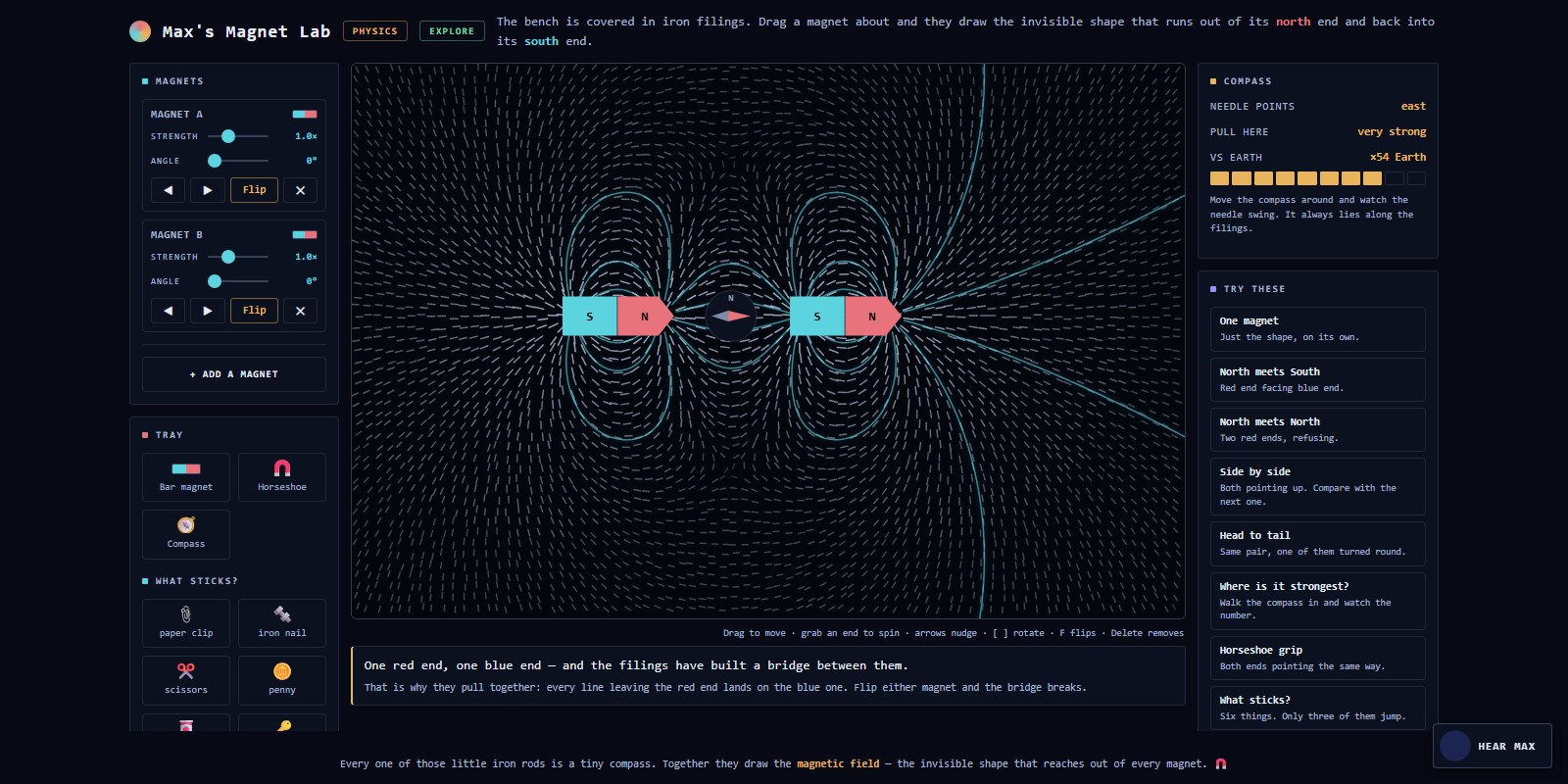
Max's Magnet Lab
Iron filings, two magnets, and one invisible shape
drop magnets on a bench of iron filings and watch the invisible field appear
what this teaches: magnetic fields, field lines, opposite poles attract, like poles repel, only some metals are magnetic
What you'll learn
- That a magnet has a field around it — a real shape in the space nearby, not just a sticky end
- That opposite poles pull together and matching poles shove each other apart
- That the pull gets weaker very fast as you move away — walk the compass in and watch the number climb
- That field lines run out of the north pole and back into the south pole, and never cross
- That 'metal' and 'magnetic' are not the same thing — copper, brass and aluminium do nothing
How to play
- Drag a magnet around the tray and watch the filings redraw themselves — grab either end to spin it.
- Try the experiment buttons. North meets North is the surprising one.
- Walk the compass towards a pole and watch the strength number climb.
- Drop the paper clip, the penny and the key near a magnet and see which ones jump.
FAQ
What age is this for?
About 6 and up. There is nothing to read on the bench and no numbers to work out — a small child can drag magnets around and see something happen, while an older one can chase down why.
Are the field patterns real?
Yes. Every filing works out the pull where it lies, from the actual magnets you placed, sixty times a second. The same calculation moves the paper clips, turns the compass, and pushes the magnets apart — nothing is a stored picture.
Does this game use real magnet physics?
It treats each magnet as two pulling points, one at each end. That is a simplification — a real magnet is a solid block of aligned atoms, and single magnetic poles do not exist on their own. But outside the magnet it draws almost exactly the pattern real filings make.
Why doesn't the penny stick?
Because a penny is copper, and copper is not magnetic. Nor is the brass key or the aluminium can. Only iron, steel and a couple of other metals feel a magnet at all, which is exactly the surprise the tray is there to spring.
For parents and teachers
The moment to wait for is two magnets, matching ends facing, pushed slowly together — the gap that will not close is a child's first experience of a force they can feel but not see. Worth following up with real fridge magnets and a saucer of paper clips; this bench and the kitchen table teach the same lesson, and doing both makes it stick.
 Max's Physics Playground
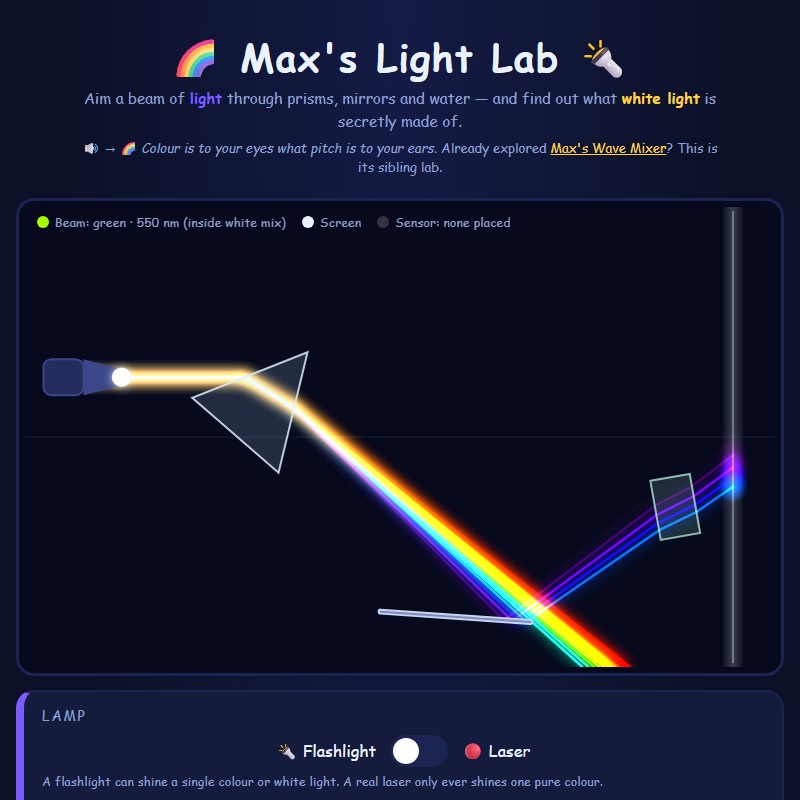 Max's Light Lab
 Max's Spark Bench